Monday, March 25, 2013

"A Woman on the Roof" - Characters


In this unit, lust, betrayal, and attraction, the short story A Woman on the Roof clearly portrays the theme of lust.  All of the characters in this story, play a major role, each one being throughly defined.  The extremity of the characters is what makes the story and helps to understand it.  Set in the 1960’s of London, a woman decides to go tanning on the roof of her suburban home.  
Passerby’s of the woman have all different reactions to the situation, the strongest reaction coming home Stanley.  Stanley is in his mid 20’s and is recently married.  He has a plethora of emotions, from excited, to pissed, to extreme anger.  It seems though, that the main reason he feels this way is because of his outrage of the woman’s audacity.  I believe that he is thinking to himself, “what if it were my wife up there”.  I also think that he is so outraged because he is ashamed of himself for being tempted and looking up there at the woman sunbathing.  
While Stanley’s reaction is extreme anger and resentment, Tom has a completely different view on the woman.  This is where the theme of lust in the story takes over.  Tom is 17 and he very mush believes he is in love with this woman, when in reality is just “lusting” over her.  All day he thinks of her and how he is going to muster up the confidence to be able to go to her and ask her out.  When he finally does, he is rejected.  Out of anger he drinks.  This shows how naive and immature he is as a teen.  His idea of love is not completely developed.  His love for this woman on the roof is filled solely by the idea of her.  Being on the roof, dressed half naked, forces Tom to come up with ideas of what she is like in his own head.  Tom thinks that she is confident and bold.  To him, she holds the power of what he is going to do.  But his “love” that he thinks that he has for her, is just lust and infatuation.  He actually knows nothing about the woman and is only in love with the infatuation of her.   
Harry is the oldest of all of the boys and men that walk by the woman on the roof.  Harry is older, roughly 45 years old.  As he sees the woman, he doesn’t have nearly as extreme of a reactions as the others.  He is not as infatuated.  His age and maturity show because he is not one of the men cat calling at the woman, he is being respectful.  His age and maturity also show is experience.  He has seen much in his lifetime, being married for a very long time.  
Lust, betrayal, and attraction are all seen by all of the characters throughout The Woman on the Roof.  Lust seeming to be the main theme that takes over, is shown dramatically by Tom.  Without the extreme definitions of each character and how they feel and view the woman, the story would not be as understandable.  The characters help to drag the reader to each different view point of each character, Stanley, Tom, Harry and the Woman.    

Monday, March 4, 2013

The Metamorphosis: Close Reading

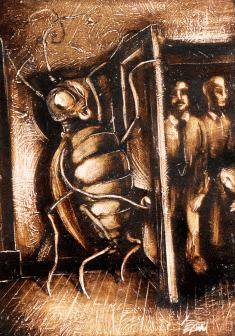
     The Metamorphosis, by Franz Kafka, seems from the surface as very simple story of a man turned to bug.  But after close reading, you can see that this story is actually very complex.  There are factors that play into ever aspect of the story, including the characters, the many different themes and symbols, and also the point of view.  

     The characters of the story all have deeper insights.  Gregor has always lived his life to please his family, being the sole supporter of the family.  He always care for others over himself.  He is not entirely happy with his job and he is extremely sad and pitiful.  Being this way, could be what some people assume was the reason of his morphing into a bug.  Gregor is alienated from his family, prior to being a bug, but once turned into a bug, he is alienated from the entire world.  He accepts all of the hardships and misfortunes that are brought upon him without any complaints.  While Gregor is a bug, his humanity never fully disappears and goes away.  The family as a whole is very unsympathetic towards Gregor, before and after his bug transformation.  They are all very reliant on Gregor and are lost without him during his bug stage.  They are very quick to write him off, being extremely neglectful.  Grete is the only person that cares for Gregor, before and after is he a bug.  Grete is Gregor’s caretaker.  When he is morphed into a bug, he steps aside, letting Grete prosper and blossom into a woman.  This was like a role reversal.  

There are many different themes and symbols throughout the story.  A major theme in the story is to appreciate what you have.  The saying “you don’t know what you have until it’s gone” is very prevalent.  The family is so reliant on Gregor and don’t realize that until he is already transformed into a bug and can no longer provide for them.  This then makes them before extremely quick to get rid of him and forget about him.  The main symbol of the story, in my opinion, is food.  Food is seen as a symbol of value.  The food represents the way that the family acts, feels and passes judgement toward Gregor.  Food is also what Gregor provides for the family before he is transformed into the bug.  After he is transformed he can no longer give what he was giving to the family, food being one.  The setting of the story, is somewhat of a symbol as a whole.  Gregor’s bedroom goes from being a home to a prison and a cage.  The main symbol is the Lady in Furs picture shows a connection to humanity and normalcy.  Looking at the picture, Gregor is able to hold on to the last bit of humanity that he has.  He can look at the picture as something that he would want to embody and strive to be.   

The point of view of this story, being the last close reading done, is very vague.  The author leaves the reader in the dark on many different things.  Much is left unexplained such as, why he was morphed, why the family wasn’t working to help in the first place, and how her could transform back.  The author uses this tactic to leave the story up for interpretation for the reader.  For myself, I enjoyed this because it made the story more enjoyable to read.